BS (Data Science)
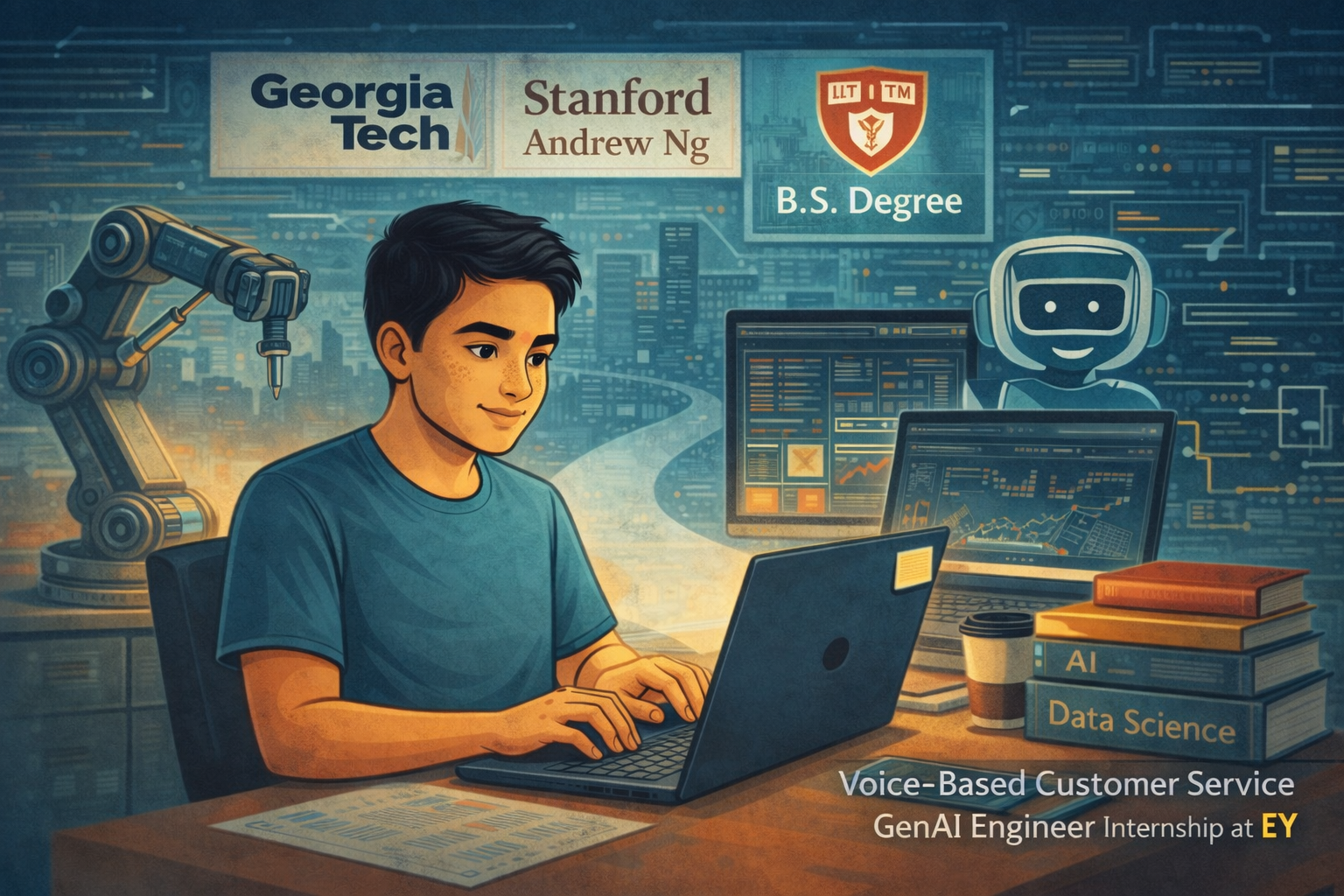
Archit Handa’s first brush with AI came from a robotic arm. Growing up in Gurgaon, he was fascinated by machines and the logic behind that made them move. A Class 11 Yashawa internship introduced him to the teach pendent – controlling a robotic arm in just a few inputs. “I just had to give two, three commands… and I was in control,” he recalls. Later, Andrew Ng’s Stanford AI course turned that spark into obsession with CS, AI, and Data Science.
After Class 12, Archit was accepted to Georgia Tech in the US. But COVID uncertainty forced him to drop it. With the JEE timeline already behind him, he began scanning for other options.
While searching, an ad popped up: IIT Madras was launching its first non-campus program in Data Science and Applications. He clicked out of curiosity, assuming it might be like a MOOC, but digging deeper revealed a full-fledged degree with a course list that matched what he wanted to study. He decided to attempt the qualifier, got selected, and began the IITM BS journey.
As the foundation level began, it felt surprisingly accessible at first. “Is this really an IIT degree?” he questioned. But later it made perfect sense – “People come from different backgrounds… the playing field had to be leveled,” building essential CS foundations was the priority. As he moved through the program, it got seriously hard; no more questions about IIT quality!
“It was really difficult managing different subjects that all demanded different approaches,” he recalls. So he adapted accordingly and for him, that shift from “finish fast” to “learn well” became one of the degree’s biggest contributions.
Alongside the academics, Archit took up an eight-month internship at EY as a GenAI engineer. “We built voice-based customer service agents to replace traditional IVR with intelligent chatbots.” Courses were making a lot more sense in practice. “I could see the direct impact… something of certain use.” He also realized the program had been preparing him for something deeper, since real-world systems are rarely built with a single all-purpose tool. “Dedicated modules… do what they do at the best quality,” he explains, and making a solution work in practice often means picking the right tool for each layer and integrating them carefully, exactly the kind of thinking his coursework had been training him to do.
That industry exposure also sharpened his view of academic performance. Despite strong academic performance, Archit is careful about how much weight he gives to grades.
“Grades or CGPA only reflect one single exam day, not the real journey,” he says, because they can’t capture the choices, constraints, and consistency that shape learning over time. That’s why learning matters more to him, especially the hard and challenging kind that builds real skill. “I really enjoyed the difficult courses most because they pushed me,” he says, and for Archit, true growth lives in the struggle itself.
Post BS, he didn’t feel like stopping. New topics kept appearing, and the field kept moving, so he chose the PG diploma to stay connected to what he calls a “dramatically changing” domain where new LLMs, architectures, and research show up constantly.
His message to anyone reading is simple: don’t enter the program for the tag alone. The real value, he feels, is in committing to the rigor, staying curious, and letting the journey – ups, downs, and all, teach you how to keep learning long after a term ends.
– written by Nehansh Kesharwani