
BS (Data Science)
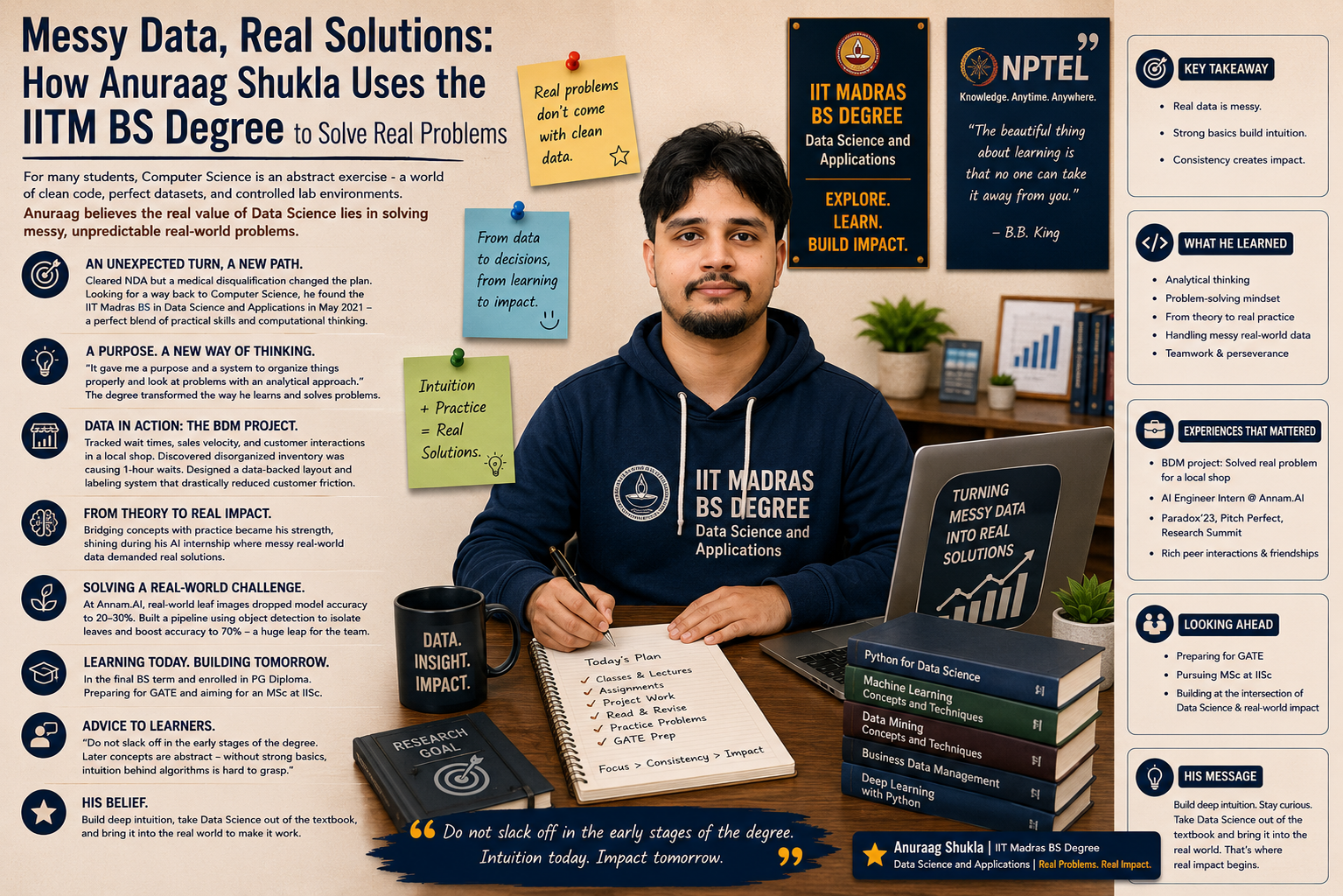
For many students, Computer Science is an abstract exercise – a world of clean code, perfect datasets, and controlled lab environments. But for Anuraag Shukla, the true value of Data Science lies in its ability to untangle the messy, unpredictable realities of the real world. Anuraag’s journey into the IIT Madras BS Degree in Data Science and Applications began with an unexpected change in direction. Despite successfully clearing the National Defence Academy (NDA) entrance examinations, a medical disqualification kept him from joining the Armed Forces.
Looking for a path back to his interest in Computer Science, he faced a common frustration: traditional engineering entrance exams prioritize Physics and Chemistry over actual coding aptitude. “I wanted to study Computer Science, but I didn’t want to study Chemistry all the time,” Anuraag laughs.
When he discovered the IITM BS program in May 2021, he found exactly what he was looking for – a curriculum that combined practical technical skills with a strong focus on computational thinking.
What he didn’t expect was how quickly the degree would change the way he interacted with the world around him. “First of all, it gave me a purpose,” he explains. “It provided me with a system to organize things properly and to look at problems with an analytical approach.”
That analytical approach was tested during his Business Data Management (BDM) project. Refusing to just check a box for a grade, Anuraag sought out a local shop owner struggling with frustrated customers. Using frameworks learned in the degree, he tracked wait times, sales velocity, and customer interactions. The data revealed a glaring issue: disorganized inventory meant customers waited an hour just to find fast-moving products. By mapping out a new, data-backed layout and labeling system, Anuraag drastically reduced customer friction.
This ability to bridge theory and practice became one of his defining strengths, shining brightest during his recent internship as an AI Engineer with Annam.AI. Tasked with classifying 19 plant diseases from leaf images, Anuraag quickly discovered that real-world data is messy. While existing AI models boasted 95% accuracy on pristine lab images, their accuracy plummeted to just 20-30% on blurry, real-world agricultural photos.
Anuraag had to engineer a fix. Realizing that simply upscaling the low-quality images erased the vital details the AI needed to diagnose the diseases, he pivoted. He built a pre-processing pipeline using an object detection model to scan the noisy photos, isolate and crop the leaves, and then feed them to the classifier. This multi-step fix boosted real-world accuracy to 70% – a massive leap forward for the company.
Currently in his final BS term and registered for the upcoming PG Diploma, Anuraag is setting his sights on the GATE exam and pursuing an MSc at IISc.
Looking back at his journey from the foundation level to his AI internship, he has one crucial piece of advice for new students: “Do not slack off in the early stages of the degree.”
“People think the beginning is the hardest part, but for someone without prior experience, the later stages are often much more challenging.” Anuraag warns.
“When you get into the abstract part of things at the degree level, you will not understand the intuition behind the algorithms if you haven’t paid attention in your Diploma and Foundation subjects.”
For Anuraag, building that deep intuition was the key to everything. It allowed him to take data science out of the textbook, bring it into the real world, and actually make it work.
~written by Nikita Nanduri