BS (Electronic Systems)
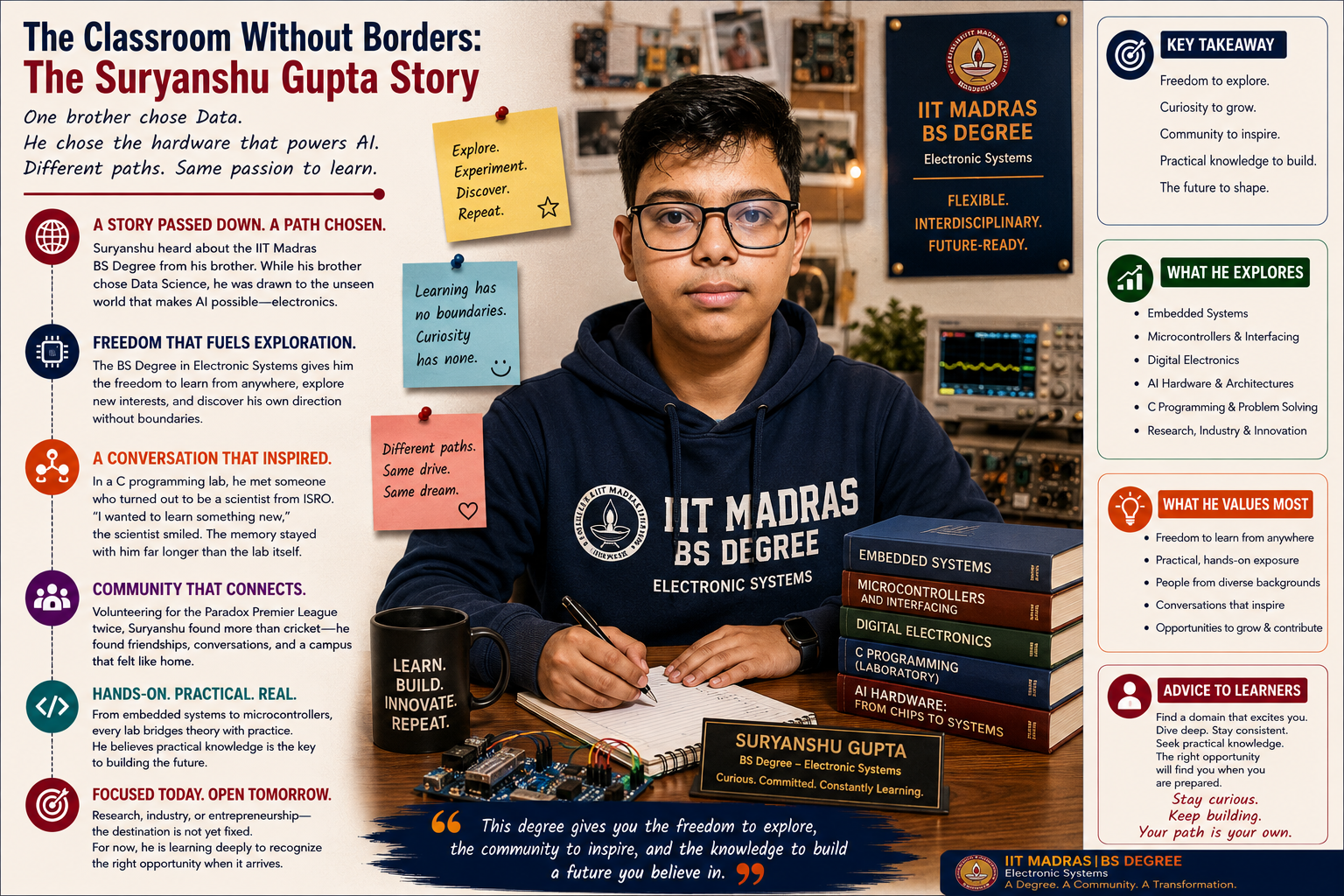
Brothers often inherit the same stories. Sometimes, they write different ones. Suryanshu Gupta first heard about the IIT Madras BS Degree from his brother, who was already pursuing BS in Data Science and Applications. The programme intrigued them both. The disciplines did not. While one gravitated towards data, the other found himself drawn to something less visible; the hardware quietly powering the age of Artificial Intelligence. For him, the future of AI has never been limited to algorithms. Every intelligent system ultimately depends on processors, embedded systems, and the electronics that keep it running.
It was this conviction that led Suryanshu to the BS Degree in Electronic Systems. The programme, according to him, has granted him with freedom.“
Not merely the freedom to learn from anywhere, but the freedom to explore, experiment, and discover interests without feeling confined to a predetermined path.” he describes.
For someone still navigating where he ultimately wants to go, that freedom has become one of the programme’s most profound strengths.
One memory, in particular, distils that feeling with unusual precision. During a C-programming laboratory session, Suryanshu struck up a conversation with the learner seated beside him. Expecting to meet another undergraduate, he instead discovered that the person was a scientist from ISRO. Curious, he asked why someone already working at one of India’s most prestigious scientific organisations had enrolled in the programme. The answer caught him by surprise. “I wanted to learn something new,” he explained with a smile. “I had some free time, so I enrolled in the programme.”
It was, Suryanshu admits, far more memorable than anything covered in the lab that day. In one room sat undergraduates, working professionals, and scientists – each pursuing knowledge for entirely different reasons, yet occupying the same space as equals. That, he realised, is a rare thing. Most institutions sort people by age, credential, or stage of life. This one simply didn’t.
Beyond academics, Suryanshu has twice volunteered as part of the organising team for the Paradox Premier League. He laughs that cricket holds little personal appeal, yet Paradox remains among his most cherished memories, not for the sport, but for the people it gathered. Walking over 20,000 steps a day across campus, meeting learners from different corners of the country, and exchanging ideas in passing became as formative as anything the curriculum offered.
His advice to fellow learners reflects the same instinct for depth over breadth. “Seek out practical knowledge”, he says.
“Find a domain: embedded systems, microcontrollers, hardware architecture, something that genuinely excites you,” he says. “Then stay with it.”
Suryanshu doesn’t yet know exactly where his journey will lead. Research, industry, and entrepreneurship all remain possibilities. For now, he is simply focused on learning enough to recognise the right opportunity when it arrives.
There is something fitting about that uncertainty. A degree built on exploration rarely expects everyone to arrive at the same destination. Suryanshu is still finding his own, and, for now, he seems perfectly content with that.
~written by Shambhavi Shekhar